

Book 1 of The Chronicles of Aertu
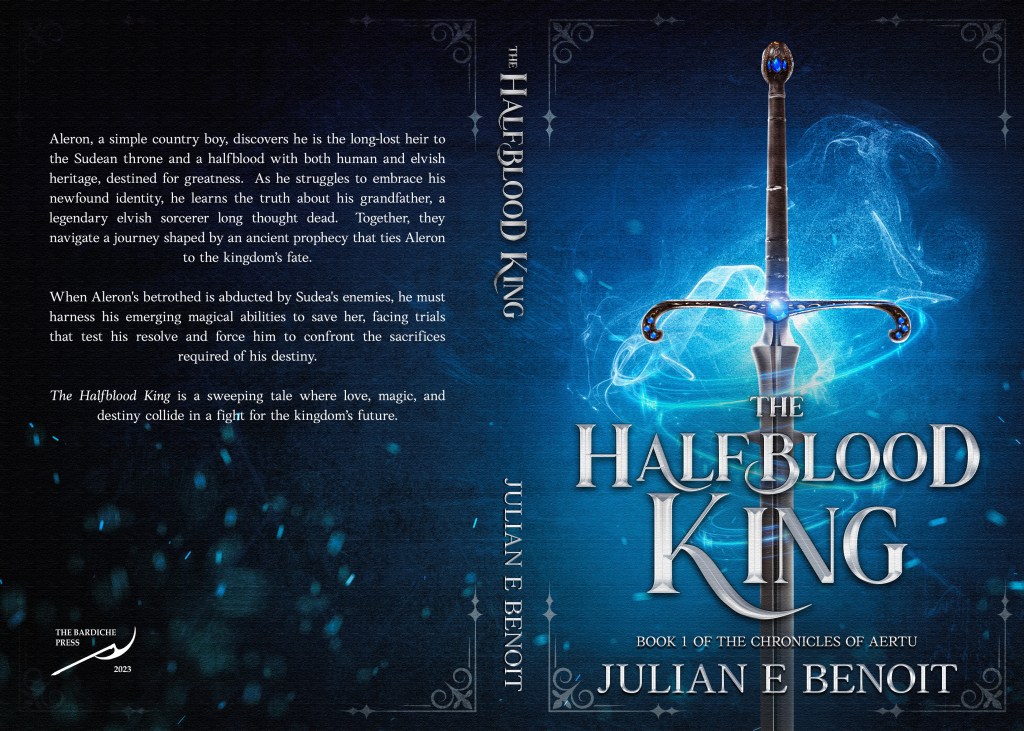
Here is a sample from the first of the series. Copyright 2014 and 2025, Julian E Benoit, The Bardiche Press
Prologue
Gurlachday, Day 7, Harvest Moon, 8747 Sudean Calendar
Valgier couldn’t imagine being more content than he was at this time of his life. His occupation as a woodsman and primarily, his charcoal making business, were providing well for his young family. He built them a modest home in the foothills of the Southwestern Blue Mountains, managing to finish it shortly before the birth of their son Aleron. His customers included not only the men of the local villages, but also the dwarvish smiths of the mountains, who preferred charcoal to the rock coal they mined for the forging of their finest blades. They claimed rock coal would make the steel brittle, but charcoal was cleaner. It made for a booming business and Valgier put aside most of his other activities to devote enough time to keep up with the orders. He was happy that he could provide a good living for his wife and son.
The boy was growing well and at two years was handsome and tall for his age. In a few years, he would be able to help his father in the forest. The boy’s mother, Audina, insisted on the name Aleron for their son. Valgier, at first, thought it a bit pretentious to name their son after the ancient king of Sudea, but the name grew on him, and it seemed to fit the boy well. His wife had a very persuasive way about her, as well as being the most beautiful woman he had ever seen. He could never tell her “No,” but in return, she never asked for anything unreasonable. The name was a common enough one and had been for the millennia since the King gave his life in the final battle against the Nameless One. He was greatest of all the rulers of Sudea, bringing the kingdom to its pinnacle of power and influence. The trend may have continued indefinitely, if not for the decimation of the noble households from that brutal war. His thoughts wandered back to Audina, as his footsteps followed the familiar path to their home. He remembered how they had met:
He just returned to the village from a fortnight working in the forest, filthy from the baker’s dozen charcoal heaps he left smoldering behind him. He brought his mule to the stables and carried his bag to the room he maintained above the tavern, requesting a couple pails of hot water from the publicans prior to climbing the stairs. Two years before, he sold his family’s homestead to the south after they, along with his betrothed, died of plague. At twenty years of age, he had nothing but the money from the farm and headed north to begin anew.
About a half bell after entering his room, he heard a knock at the door. He opened it to the sight of the most stunningly beautiful woman he had ever laid eyes upon, her lustrous golden-brown hair framing features almost too perfect to be real. In her hands were two steaming pails of water. He stammered a thank you, as he quickly moved to relieve her of her burden. She smiled at that, and it seemed as if the heavens opened up before him, so beautiful she was. In the days to follow, he learned that she also lost her family in the plague and moved here from the northwest coast, bordering the Elvish Colony. He sometimes suspected that she had some elvish blood in her veins, not unheard of in the border country, though she always denied it. They had been together nearly three years now and she was still as lovely as the day they met.
As he entered the house, he set his broadax by the door and called out to his wife; there was no answer. “Aleron!” he called to his son next, with still no answer. He could smell supper cooking and wondered if they might be out behind the house. The assassin’s blade slashed through his throat as he made his way past the kitchen, to the back door. His last vision was of oddly slanted eyes, so dark no pupils were visible, staring at him from a darkly tanned face. The assailant’s straight black hair was tied back, out of his face. He slumped to the floor, vision dimming as his life’s blood flowed across the front of his jerkin and realized in despair, that his family was most likely dead as well. Just like last time, he was powerless to save the ones he loved. It was with profound sadness that he slipped into unconsciousness and the life left his body.
The foreign killer left the man in the center hall, along with the dead woman in the kitchen and made his way to the bedroom, where the young boy lay drugged and unconscious. He picked the toddler up and slung him over his shoulder. His Master had been very clear in his instructions, that this boy would come to no harm, physically, or emotionally. The assassin made sure to render the lad unconscious before killing the parents. He had a good idea why this boy was important; his mother’s elvish features became apparent as whatever sorcery she used to conceal them died along with her. This child was likely one of the few half-elves alive and potentially of great value to the Master.
***
Hadaras rode hard down the wooded trail, the high peaks of the Blue Mountains occasionally visible through the trees over his left shoulder. The non-descript brown mare he rode was capable of impressive speed, as befitted its lineage of elvish warhorses. He rode since late morning, as soon as he sensed the malevolent presence closing upon his daughter’s family. He rarely strayed far from the family he secretly watched over. He sensed too, that he was too late to save her, or her human husband, but the boy still lived. He was close now. He slowed the mare to a trot and cast out with his senses.
The assassin rode northwest, a packhorse trailing behind with a small limp bundle secured across its back. The boy shouldn’t come around until well after he set camp for the night. Then he would tell the boy of the fire (he did set the house ablaze upon departing) and how he was too late to save the boy’s parents. He would explain to the child how he would take him to a place where he would be cared for, just like his real parents would have. Some trauma was inevitable, but the boy was young enough that it wouldn’t cause any lasting damage. He was mulling over these thoughts when he came upon the lone horseman on the trail ahead. It was a swivin elf, with no business in this territory other than with the assassin himself. Warded against elvish sorcery, he was confident in his ability in any one-on-one fight with conventional weapons.
“Give up the child and I may let you live Kolixtlani,” the old elf called out.
“Let me pass unhindered old man and I may allow you to live. I do not fear your elf magic,” the assassin replied, concealing his consternation at the elf’s knowledge of his nationality.
“Very well, have it your way,” the rider answered back. With a lazy wave of his fingers, a sliver of blue light projected from the elf’s hand and neatly sliced through the other’s neck. There was a look of shocked disbelief in the assassin’s eyes, right before his head toppled from his shoulders. The hands still gripped the reins tightly, as the body slowly slumped from the saddle, no blood flowing from the cauterized stump of the man’s neck.
Hadaras dismounted and made his way to the pair of horses. He recognized the pack animal as the horse belonging to his daughter’s mate. He laid a hand on the bundle that contained his grandson and sensed that the boy was unharmed. He then turned his attention to the other horse and its rider, prying the dead fingers from the reins and laying the body on its back. He picked up the head by its hair and looked into the still open eyes, saying, “whoever you are, that sent this man, you have failed again.” He then threw the head to the side of the path. Examining the body revealed the warded sigils the killer assumed would fend off Hadaras’ sorcery. The sigils still glowed faintly red with the unsavory magic of the Adversary, activated by the touch of elvish magic. There was powerful magic invested in these, but a simple bend of his will dispelled it back to the source. That will make someone flinch, he thought to himself. Those wards must have been the reason the assassin was able to catch Audina at unawares. She had some mastery of sorcery, but not on par with her father’s.
He led the horses to his own, tied the reins together and then returned to the corpse on the path. Grabbing one wrist and one ankle, he lightly flung the body to the side, to join its head. The blue flame he conjured burned with fierce intensity, consuming all, including the teeth. All he left behind was a dusting of fine gray ash. Returning to the horses, he hooked the reins of the assassin’s horse to his mare’s saddle and untied Aleron, removing the bag covering him. The little boy’s face held a placid expression, as Hadaras carried him back to the lead horse. Resting the child on his shoulder, he remounted and then coaxed the animals forward, past the patch of ash, toward the house of his own child.
As they rounded a bend in the trail, Hadaras could see the still burning wreckage of the house and knew that the child’s parents were both within. He dismounted and found a patch of soft grass, away from the wreckage, to lay his grandson. He made his way closer to the house and its attached stable. The heat was intense, but the blue nimbus enveloping the elf protected him from the brunt of it. There would be nothing salvageable now, he determined. He stepped back and raising his arms, he added his own blue fire to that of the blazing home. There would be no charred remains for the villagers to find, no bodies to count. It was in keeping with the funerary practices of his people as well and he voiced a prayer to speed their souls’ return to the Allfather.
Hadaras collected his grandson and remounted the mare. Turning the train back up the path, they made their way towards the border with elvish territory. The thoughts going through his head were much like those of the assassin as he made his way up the same path. How would he explain the loss of the child’s parents and everything he ever knew, without traumatizing the boy? He could feel Aleron stirring against his shoulder and knew he would awaken from his stupor before long.
A bell or more passed before they came upon the glade where he intended them to camp. Hadaras wrapped the small child in a blanket and laid him down near the well-used fire ring. Picketing the horses nearby, he went through the assassin’s bags and found, surprisingly, a collection of Aleron’s toys and some extra bedding, indicative of an intention to keep the boy comfortable. He chose a well-worn stuffed doll and brought it to where the little boy lay. Then he proceeded to build a fire. He would hide the lad in elvish territory for a time, safe there, even as he himself hid from his own people. He needed time to prepare this boy for a future that would be anything but uneventful. As well, he needed to figure out how the assassin made his way through elvish, or dwarvish lands, in order to attack this family. It was highly unlikely for the Kolixtlani to choose the southern route, through the heavily populated lands of men. He heard Aleron whimper and looked over to see him clutching the toy tightly to himself. Hadaras felt for the boy’s mind and sensed that it was troubled. The boy knew something was amiss, though he could not comprehend what.
Chapter 1
Carpathday, Day 4, Sowing Moon, 8757 Sudean Calendar
Aleron sat with legs dangling over the side of the wooden bridge. His friends Barathol and Geldun were there beside him. All three had their fishing poles in-hand, lines dangling into the languid flow of the river below them. Cork bobbers tugged at the ends of the lines, attempting to follow the current out to sea. Steel hooks lurked inside balls of dough, infused with bacon grease, several inches below the surface, as the boys attempted to lure the local river carp to their demise. If they caught anything, the boys’ mothers would complement them upon their triumphant return. The other two, that is, Aleron barely remembered his parents. He lived with his grandfather and cousin, and they were the only family he had in the world. His cousin Jessamine was much older, in her twenties in fact and had lost her parents during the plague, before Aleron was born. His grandfather Hadaras was old, maybe sixty or so, but had an ageless quality that was difficult to define.
Of the three boys, Aleron was the youngest, not quite past his twelfth year, but he was the tallest, as well as the brightest, of the three. His friends usually cast him as the ringleader for their endeavors, both legitimate and not. The exception being when they fell into trouble with the older boys in the village, then Barathol took over. Though not as tall as Aleron, he was much stouter and quite adept with his fists.
Aleron had not always lived in the village, only moving there about three years prior. They lived alone in the forest, far to the north, until one day Grandfather stated that they should move to a town, so Aleron could learn about other people. He didn’t always like the things he learned about other people. Geldun and Barathol were the only boys his age in town, and he quickly joined their alliance against the cruel older boys of the village.
One day, somewhere near his ninth birthday, he wandered home with a bloody nose and a bruised cheekbone; they were unable to outrun the older boys that time. Jessamine set immediately to cleaning up the bloodied, teary-eyed youth, attempting to comfort his bruised ego, as well as his physical injuries. Grandfather looked at him and, with kind amusement in his eyes, said “It looks like it’s time for you to learn how to fight.” From that day forward, Grandfather spent one or two bells each day teaching Aleron fighting techniques. He claimed to have been a soldier once, long ago and to have lived many years among the elves, learning from them as well. The training started with simple punches, kicks, and grapples, progressing over the years to more advanced techniques for subduing an opponent, as well as various weapon forms.
Though Grandfather warned him not to reveal too much of what he learned to those outside the family, he felt the need to practice with boys more his own size and he showed what he learned to his two close friends. As it turned out, Barathol was a natural talent, taking to the techniques like a fish to water and quickly surpassing Aleron in skill, while Geldun proved to be of middling talent, though solid in his tenacity.
The boys often dreamed of leaving their small village of farmers and woodsmen, to become sailors or soldiers for the Kingdom of Sudea; still a kingdom though it had no king for over a thousand years. Their town was only a few miles from the coast, so all three of them had seen the navy ships moored at the bay and the sailors swaggering through the streets of the port city, dropping coin like it was their last day with the living.
Though Grandfather didn’t appear to have any particular line of work to apprentice Aleron to, he encouraged Aleron to help the neighbors whenever possible. Aleron especially liked helping the woodsmen, because that had been his father’s trade and it gave him a sense of connection to the man for whom he had but fleeting memories. When townsfolk became curious about Hadaras’ apparently comfortable retirement, they were told he was a retired soldier, generously rewarded for his time in service, who decided to move to the countryside in order to better raise his orphaned grandchildren.
Aleron’s companions were both the sons of farmers and days like today were becoming rare, as their responsibilities at home consumed more of their time. It was widely assumed that Aleron, not having a trade to follow his father into, would be the one most likely to take to the sea or join the army.
***
Hadaras watched the boy leaving that morning, and thought of how much Aleron reminded him of his daughter, Audina, who had given birth to the boy. He was tall for his age, and had inherited the golden-brown hair, and silver eyes of his mother, as well as her stubborn streak. The lad had it in his mind that he would become a soldier or a sailor, and there was no detracting him from that line of thinking, though Hadaras was certain that he was destined for far greater things than that. He thought back on that day, over fifteen years ago, when his daughter announced that she was getting married:
“Father, I have decided to be married,” she told him.
“That is certainly good news,” he replied. Audina had been born in the colonies, well after the Great War, so she was relatively young, but at five centuries of age, it was about time she chose a mate. “Do I know him?”
“I’m sure that you do Father; he is from a fine old family.”
“Good, what is his name and what family?”
“Valgier, of House Sudea,” she replied frankly.
Hadaras’ demeanor took on a dark cast, as he stated, “That is a human, who does not even know the house to which he is heir to. House Sudea is extinct, as far as men are concerned. I have already determined that he is not the one.”
“I am aware of that, Father and I have been watching him since he was a babe, just as you have. I have seen that I can love him, for he is pure of heart and a vision has told me that he is to be the sire of the one.”
“And what makes you believe that you are to be the mother of the one? I have watched this family for nearly a thousand years, ever since I discovered the bastard nephew of Alagric’s, the son of his dead brother, living on the streets of Arundell. I have waited since, for the right time and the right heir, to come together. I have worked all these years to assure the family remains far from power, to avoid any inopportune discovery of their birthright. What makes you think you know better?”
“Father, the prophecies have all stated that a millennium will pass before a new king rises to the throne. If the heir is to be born, it must be soon,” she spoke.
“The prophecies were not that specific; they were all written to say “millennia” not precisely how many. Plus, they say nothing of how you are to be involved,” he retorted. “I should know, I wrote some of them myself!”
“Though I realize why you hide who you are from our people, it does not change the fact that we are of the royal house of Elvenholm, and you abdicated in favor of your younger brother. A child of this union would reestablish the half-elven royal line, with greater legitimacy than ever before, having blood ties to both Royal House Sudea and Royal House Elvenholm,” she replied coolly. “In addition, the vision came to me, because it pertained to me. Perhaps you should seek revelation as it pertains to you, Father, as to whether what I tell you is true or not. Regardless, my decision is made, and I will be journeying to Sudea soon.”
Hadaras often thought of that fateful day and of those that followed, when he would pass through, posing as an itinerant craftsman, plying his wares to the remote villages. Valgier never knew it was his father-in-law who stopped by every few months, selling tools and trinkets, repairing tack and shoeing horses and mules as needed, though the old farrier always took an interest in how Aleron was doing.
Hadaras thought most of all about the day he had been too late to save them from the Kolixtlani assassin who murdered the young couple. The agents of the Adversary knew of Aleron’s existence and though they may not know that he is anything but a halfblood, that fact would be enough for them to want him. Halfbloods often developed frightening powers, when the pure spirit of the elf blended with the impure heart of the man. A halfblood sorcerer could master both dark and light aspects of magic and they were highly sought after by the Nameless One during his time in power. This casting about for them by his agents indicated an increase in his power. The old wards of binding had weakened after all these years. He renewed them after the murders, travelling in secret through the jungle to Immin Bul, but he was certain the Adversary would find some way around them eventually.
***
By mid-afternoon, Aleron was on his way home with two good-sized carp dangling from a stringer. They were having a good haul, but his friends needed to return home for their chores. Aleron needed to get back home as well and to get the fish cleaned quickly. Grandfather promised to start teaching him an elvish dual-scimitar form that looked viciously effective when he demonstrated it yesterday.
Chapter 2
Zorekday, Day 18, Squash Moon, 8759 Sudean Calendar
Sweat dripped into Aleron’s eyes as he circled Hadaras around the makeshift ring in the stable. They were practicing greatsword this afternoon and the summer heat was oppressive. Somehow, the heat never seemed to bother the old man; he was barely perspiring. Aleron shook his head to dislodge some of the moisture. If he were to reach up to wipe his brow, the bout would be lost. Hadaras was incredibly fast and never let an opening pass. Aleron had the bruises to show for it too. Both were fighting in a right-handed stance and Hadaras stepped forward with his left foot, taking a low chop to Aleron’s forward leg. Aleron dodged back to avoid the blow, then surged forward to take his grandfather’s exposed left shoulder. The old man rolled left, bringing the sword up vertically to block the incoming strike, then counterstriking to Aleron’s left collarbone, bringing him back to his original guard position. Aleron barely rolled his wooden practice sword left to protect his shoulder and then it was as if his reflexes saw the next move before his mind had even processed it. As Hadaras’ sword was deflected, Aleron snapped the tip of his into a backhand strike to Hadaras’ own shoulder. Then, as his grandfather released his right hand from the hilt, Aleron rolled his blade into the same offside leg strike his opponent had just attempted. Having no way to defend his forward leg, Hadaras took the blow and dropped to his knees. Aleron circled Hadaras, looking for an opening, as the old man pivoted to remain facing him. To yield was never an option during these bouts with his grandfather, so he would have to finish it. He teased out feints, which Hadaras either ignored, or deftly blocked. Finally, as Aleron saw his opening and closed in for the kill, the opening suddenly disappeared and the tip of Hadaras’ sword took Aleron in the midsection, knocking the wind out of him.
As Aleron stooped into a crouch, attempting to breathe again, Hadaras stood, saying, “Remember this Aleron: It is always possible to transform a position of disadvantage into one of strength, whether in combat, or elsewhere in your life. You simply need to think your way through the problem and wait for your opening.” He patted the boy on the shoulder as he passed and said, “Put your gear up and clean yourself off at the trough my boy. Supper will be ready soon.”
Aleron caught his breath quickly. The padded leather practice coat had rigid plates attached at key locations, to discourage serious injury. As well, the five years of daily martial training his grandfather enforced had whipped the now fourteen-year-old Aleron into excellent physical condition. Hadaras tired the youth out with pushups, pull-ups, and sprints around the yard, before any of the actual combat training took place. He often resented the warm-up training and suspected that his grandfather was only doing it so that Aleron would not win the bouts. Hadaras always told him that it was important to warm up first, to avoid injury. That did not explain why his grandfather never needed a warmup. What he failed to realize, was that his grandfather was building his strength and endurance. At the same time, he was showing him what it would be like to fight tired from the physical exertion often required to get within range of an enemy. He made his way to the cabinet where they stowed their practice gear. He removed his heavy leather gauntlets first, then the practice helm, with its skirt of heavy chain mail protecting his neck and finally the coat. He wiped down all the metal parts with an oily cloth and placed the equipment on the appropriate hanger for each. He wiped down the sword, carved from a straight-grained stave of ironwood, with the same oily cloth and placed it upon the weapon rack.
Aleron made his way to the water trough, pulling off his sodden tunic as he went. He dunked his head and shoulders into the cold water for two or three seconds. The breath exploded from his lungs when he came back up. He doused his tunic in the trough, then hung it over a fence rail to drip dry. Despite the cold water, Aleron’s face, neck and torso were still flushed red with heat. At least I’m not sweating so much anymore, he said to himself. Why does it seem like this never gets any easier? No matter how much better I get, each time is just as hard as the last. It seemed as if his grandfather had an endless capacity for ever-higher levels of combative skill. No matter what Aleron brought to the fight, Hadaras had the counterattack to match it. If the old man is still this good now, I wonder, what was he like in his prime? He must have been damn near unstoppable. Aleron had seen other old soldiers in the city before. He had noticed that his grandfather did not bear the numerous scars that those old veterans had one-and-all.
Hadaras was impressed with Aleron’s performance that afternoon. That was the first time in a very long time, that anyone has managed to tag me like that, he thought. His speed and agility are becoming more elvish than human every day. He recalled from before the war, the half-elf children of the Sudean nobles. They usually matured much earlier than their elvish cousins, reaching nearly the same level of physical prowess in sixteen years that an elf child would wait forty years to achieve. Hadaras had fought in the Great War, under a different name, over four thousand years before, and Aleron was beginning to remind him of the boy’s namesake. He looks like the man and fights like him. It’s amazing that the traits could breed true after so many generations. It’s as if I’m looking at the young prince again, after forty-one hundred years, he thought as he watched Aleron approach the house.
The king was one-hundred and five, just in his prime, when the Nameless One cut him down on that barren plain, in the midst of the vast central jungle. Crown Prince Aelwynn, Hadaras’ younger brother, fought beside the man who was his best friend and blood brother. The two grew up together in each other’s households and were fast friends for decades. Members of House Sudea were the only humans ever allowed to visit Elvenholm. The way was barred to the ships of men and even the greatest mariners of Sudea could not so much as catch a glimpse of the island nation.
“Hey Jessie, what’s for supper? Aleron hollered as he strode through the door. “I’m starving.”
“I roasted a pork shoulder, since you didn’t bring home any fish this morning, Aleron,” she replied. “Did you wash?” she asked him pointedly.
“Of course I did Jesse.”
“Don’t you give me that “Of course I did” line,” she scolded. “With you, it’s definitely not a given. Now go get a clean tunic on and make sure the dirty one gets to the laundry.”
“I cleaned it already.” Aleron declared.
“Rinsed in the trough and hung on the fence does not make it clean!” Jessamine informed the boy. “Make sure it gets inside before dark, or the coyotes will be wearing it tomorrow.”
“Yes Ma’am.”
After a hearty meal of pork, potatoes, and greens, followed by the daily chores of cleaning up after supper, Aleron took a lantern and retreated to his room. He was tired and sore from the afternoon’s exertions. Lying prone upon his bed, he resumed reading the latest book Hadaras had assigned, this one on the history of Sudea. He was just getting to the part where Azrael, the last high governor, declares the independence of Sudea from Elvenholm. The governor knew that he was nearing the end of his life and wished for his half-blooded son to follow him in leading the colony. Before then, the position was not hereditary and high governors were always elves, appointed by the king at Elvenholm. The king acquiesced, in part because he feared how a protracted war would damage his kingdom. Men were far more numerous than elves and halfblood sorcerers were extremely common in Sudea. A war between Sudea and Elvenholm would have resulted in massive losses to both sides. Aleron had read many different histories these last several years. Histories of elves, men, and dwarves, some by authors of the people discussed, others written by outsiders looking in. Hadaras taught him to read Elvish, Sudean and Dwarvish and was in the process of teaching him Coptic, the language of their neighbors to the northeast. Elvish and Sudean were nearly the same language, and he could find some common words between Sudean and Coptic, but Dwarvish was very different. Dwarves seemed to run words into each other, forming ever-larger words to communicate ideas, rather than building sentences. Hadaras told him that the language of the westmen was similar, as was that of the Kolixtlani. His grandfather even professed that the languages of the westmen and the dwarves bore so many similarities, that they must have been the same people at some time in the distant past. It seemed to be Hadaras’ intent to teach Aleron every major language in the world, for the apparent purpose of forcing him to read every single history book in the world. Aleron often wondered why his grandfather thought so highly of scholarship. He did not believe soldiers were scholarly, as a rule. At these times, his grandfather reminded him of some aged university professor. At least, how Aleron imagined one would be since he had never been anywhere near a university. There was, however, no questioning the man’s martial abilities.
***
Hadaras sensed Aleron drifting off to sleep. He sat across the table from Jessamine. They both let their guises down, knowing Aleron to be sleeping and no one near the house. To spy upon this pair would be next to impossible for any being in existence. Hadaras’ elvish features gave him a much younger visage than he normally wore. The only clue to his advanced age was his snow-white hair. Jessamine was obviously not man or elf, but something else, her skin literally glowing golden, in the dim light of the kitchen. She was aelient, an immortal child of the aelir, the ancient teachers of elves and men. Her chosen form was that of a wood nymph, the golden skin of her face and hands merging seamlessly into her gown of deep green leaves and her dark hair seemingly intertwined with vines.
Hadaras spoke first: “That boy is almost grown now. Soon, he will want to get on with his life.”
“What you say is true, my love,” she replied. “The children of men are ever so eager to make their way in the world, their time in it being so short. They are like sparks from the fire, burning so brightly, but winking out so soon.”
“Yes, they speak of the virtue of patience, because it is a concept so alien to them.”
“I have often thought that they have just as much life in them as your people, but by their nature, they plow through it in a fraction of the time. Always in a hurry, they strive for progress and conquest, to the point that they are ever on the brink of mutual destruction,” she surmised.
“They were always so inclined, were they not?” he asked.
“Yes, they were. Even so far back, as when they were all of one race, dwarves and westmen included, they quarreled among themselves, imagining differences between groups as an excuse for competition. Eventually, the imaginary divisions they created became real,” she informed him.
“Do you realize, that for all the centuries we’ve known each other, this is the first time you have validated my suspicion that dwarves and westmen were once the same people? And on top of that, you claim they have a common origin with men as well?” Hadaras inquired, with surprise.
“Yes… I suppose I let that slip,” she answered coyly. “We aren’t supposed to tell you that, but I guess our long familiarity has eroded my guard to some extent.”
“So, what were they like, these first men?”
“Well, I guess there’s no point in concealment anymore. The first men came into being in the grassland, north of the southeastern desert, in what is now Coptia. They had faces much like the westmen, but their bodies were taller and slenderer. Their skin was very dark, like the Coptians.”
“Coptia has no grasslands today. The land goes back to jungle as soon as it’s no longer tilled.
“Aertu was much colder then. The sea ice reached all the way to the northern and southern coasts and thick sheets of ice covered the far northern and southern lands. With so much water locked in ice, that there was little rain to sustain the forests. Aertu was a world of ice and grass in those days.”
“How long of a time was this…how long ago?” he asked.
“That particular episode lasted for over one hundred fifty millennia. It happens in cycles and that one ended around fifteen millennia ago,” she answered. “Just so you know, it’s moving in that direction again. The world was much warmer ten thousand years ago.”
“And I thought it was just my old bones making me think the winters were getting colder,” he observed. “Men, westmen and dwarves act very differently. How were the first men?”
“They were very much like the men of today. westmen and dwarves became less warlike when they adapted to the cold of the north,” she replied.
“Interesting, that the harsher conditions would lead to a less competitive people,” he observed. “You would think that the opposite would be the case.”
“It seems with men, that hardship often breeds cooperation. When they have all that they need, that is when they quarrel the most,” she said, then adding, “but remember, my love, there is nothing quite as fearsome in this world as a cornered dwarf, and no one would wish to face a westman on the warpath. They all have the capacity for incredible violence. Your people had to be taught how to fight. The peoples of this land have it ingrained in their very being. I believe it was the Allfather’s means of ensuring their survival in the presence of the Adversary’s creations.”
“Too true,” Hadaras replied, “but back to the subject, Aleron will soon be in a hurry to do something with his life. He has no way of knowing that he stands to live ten times the span of a normal man’s life.”
“You can only hope that we have raised him properly, so that his hastiness does not lead him down the wrong path. I do not think that anyone could have done better in preparing Aleron to rule than you, my love,” she reassured him.
“Thank you, My Dear. I just know that he has much further to go before he is ready to assume his inheritance. After one thousand years kingless, Sudea does not need a boy-king on the throne. Better to let the Steward guide the kingdom, until Aleron is truly ready. The problem is what to do with him until that moment arrives.”
“I’m sure that dilemma will work itself out, and your old friend will continue to guide the kingdom to greater prosperity. He still has a couple of years before he will be ready to leave the safety of our nest. Now come to bed you old fool.”
“Who are you calling old?” He joked, as he rose to comply.
“I’m not old,” she answered, as her features transformed to those of a beautiful, dark-haired elf. “I’m “Timeless.””
https://www.audible.com/pd/The-Halfblood-King-Audiobook/B0CJ3TFPW7
